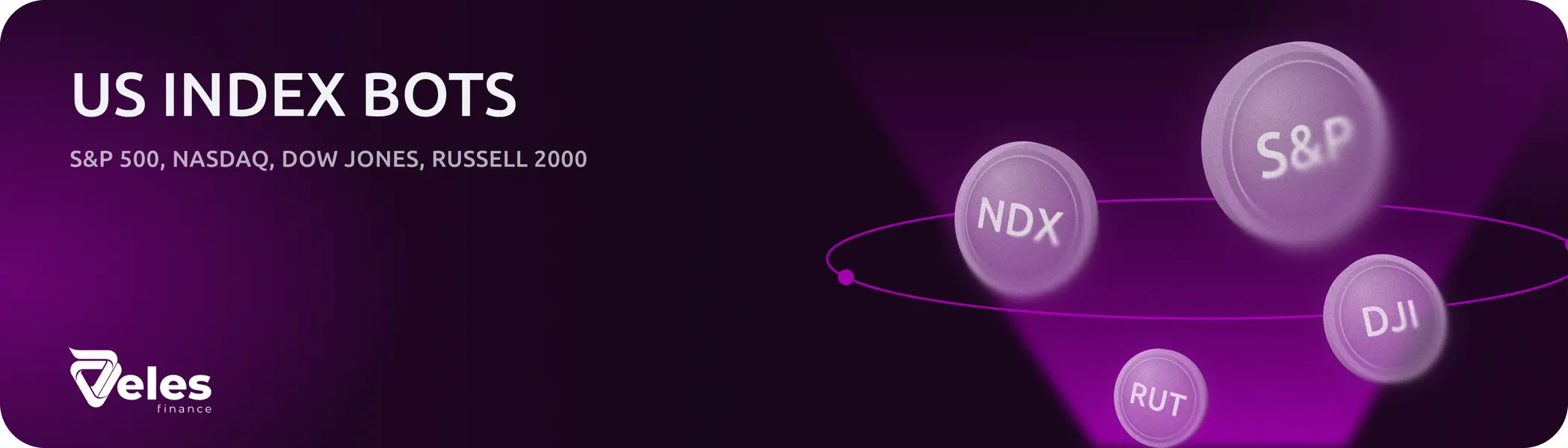
From October 30 to November 13, NVIDIA stock fell by more than 20%, while the S&P 500, which includes the company, barely moved over the same days. Indices move more smoothly than individual stocks. Are such moves enough for a bot to make money? We tested four Veles bots on the main US indices on historical data. All four finished the test in profit, including those whose index got cheaper over the six months.
Below you’ll find out what a stock index is, how the S&P 500 differs from the Dow Jones, and which bot to choose for your goal. Near the end — how much money to keep on the exchange so the bot survives a 34% market drop, like in 2020.
Results of index trading bots on S&P 500, Nasdaq 100, Dow Jones, and Russell 2000
| Index | Bot | Net profit | MAE to deposit | Deals | Price change over the period |
|---|---|---|---|---|---|
| Dow Jones | DOW JONES LONG | 38% in 11 months | 11% | 114 | up about 9% |
| Russell 2000 | RUSSELL 2000 (IWM) LONG | 30% | 10% | 569 | down 4% |
| Nasdaq 100 | NASDAQ 100 (QQQ) LONG | 21% | 12% | 172 | down 8% |
| S&P 500 | S&P 500 (SPY) LONG | 14% | 5% | 63 | down 1% |
How to read the table
- Net profit — how much the bot earned relative to its deposit after exchange fees.
- MAE to deposit — maximum adverse excursion, the largest floating loss, that is, how deep an open deal went into the red, as a percentage of the deposit. MAE tells you how much money to keep on the exchange.
- Price change over the period — what someone would have earned by simply buying the index at the start of the test and holding it to the end.
All four bots trade long with a 300 USDT deposit and x5 leverage, without a stop-loss, on cross margin.
We tested the Bybit bots on tick data over six months — from mid-May, when the exchange launched these contracts, to November 16, 2026. The Dow Jones bot was tested on BingX one-minute candles since December 2025, so compare its profit with the longer period in mind.
What is a stock index in simple terms
A stock index is a number that shows how the price of a group of stocks changes on average. You can’t buy an index the way you buy a stock, so people trade funds (ETFs) and futures that follow its movement. Companies come and go, but indices stay — and here is why.
The index lineup is reviewed regularly. Companies that got cheaper and no longer meet the index rules are replaced with companies that grew. So the index renews itself over time, while the holder of a single stock is stuck with it even if the company fades.
Each company has its own weight in the index. If its stock falls, the index loses only within that weight. NVIDIA is the largest company in the S&P 500, but even its weight in the index is about 6%. That’s why the drop in its stock in early November barely moved the index. We covered what happened to NVIDIA in the article “NVIDIA stock trading bot: short and long on Bybit”.
As a result, an index moves more smoothly than a single stock and recovers more often after drops. But when the whole market gets cheaper — in a crisis or after sudden decisions by the US government — the index falls with it. For a bot this is the main risk, and the deposit section is devoted to it.
How the S&P 500, Nasdaq 100, Dow Jones, and Russell 2000 indices differ
- S&P 500 — the 500 largest US companies. A company’s weight depends on its market value, so the ten largest companies make up more than a third of the index.
- Nasdaq 100 — the 100 largest non-financial companies on the Nasdaq exchange, mostly tech. NVIDIA’s weight in the Nasdaq 100 is larger than in the S&P 500, and the index itself swings more than the S&P 500.
- Dow Jones — 30 large US corporations. A company’s weight depends not on its value but on the price of one share, so NVIDIA’s weight in the Dow Jones is about 2%.
- Russell 2000 — 2,000 small US companies. During sell-offs such companies fall faster than large ones. In spring 2025 the Russell 2000 was the first of the main US indices to fall more than 20% from its high.
The same news moves these indices differently. A drop in tech stocks hits the Nasdaq 100 harder, and a sell-off in small-company stocks hits the Russell 2000, so bots on different indices enter deals at different times and show different profits.
Which index trading bot to choose
All bots in the selection follow the same scheme. They enter when the RSI indicator shows the index is oversold, average down with a grid of orders when the price falls, and close the whole position at a small take-profit. They differ in the index, the exchange, and the grid settings, and therefore in drawdown and deal frequency.
1. You are not ready for deep drawdowns
S&P 500 (SPY) LONG — a bot on the S&P 500 index, Bybit exchange, x5 leverage, no stop-loss.
- MAE — 5% of the deposit, the smallest drawdown in the selection
- net profit — 14% in six months
- 63 deals, every closed deal in profit
The bot enters when RSI on the 15-minute chart drops below 35. If the price keeps falling, the bot averages down with a grid of four orders, each larger than the previous one, and closes the position at a take-profit below 1%. Deals are long, 4 days on average.
2. You don’t want the deposit tied up in deals all the time
NASDAQ 100 (QQQ) LONG — a bot on the Nasdaq 100 index, Bybit exchange, x5 leverage, no stop-loss.
- in deals 61% of the test time, less than the other bots
- net profit — 21%, even though QQQ got cheaper over this time
- the longest deal lasted 10 days
The bot enters when RSI on the 15-minute chart drops below 40. Its grid of eight orders spans 8% below the entry price — the widest grid in the selection, so the bot keeps averaging down longer than the others when the price falls.
3. You want the maximum profit on Bybit
RUSSELL 2000 (IWM) LONG — a bot on the Russell 2000 index, Bybit exchange, x5 leverage, no stop-loss.
- net profit — 30%, the best result among the Bybit bots
- 569 deals, an average deal lasts 12 hours
- MAE — 10% of the deposit
The bot watches the five-minute chart and enters more often than the others. It only needs RSI to drop below 45. It averages down with twelve small orders and exits with the smallest take-profit in the selection, so it earns on short swings. The longest deal lasted 14 days.
4. You trade on BingX
DOW JONES LONG — a bot on the Dow Jones index, BingX exchange, x5 leverage, no stop-loss.
- net profit — 38% in 11 months
- MAE — 11% of the deposit; during the test the Dow Jones fell more than 10% from its high (February — March 2026)
- the longest deal lasted 19 days
The bot’s entry and grid settings are the same as the S&P 500 bot’s, and its take-profit is slightly larger. The bot was tested on one-minute candles rather than ticks, so in live trading its result may differ more than that of the Bybit bots.
If you are launching an index bot for the first time, start with the S&P 500 bot, because it has the smallest drawdown in the selection. Over the six-month test it earned 14% of its deposit, even though the index itself got slightly cheaper.
What US index futures are and what SPY, US500, and SPX/USDT mean
Veles bots trade not the indices themselves but perpetual futures on them. You don’t buy stocks or funds — you open a deal on the price going up or down and get your profit or loss in USDT. That’s why you don’t need a brokerage account; a crypto exchange account is enough. On Bybit these contracts are grouped in the TradFi section, which also has futures on stocks, gold, and oil.
The same index has different names on different exchanges. The S&P 500 is SPY on Bybit, SP500 on BingX, and US500 on OKX. The indices on Bybit follow the price of exchange-traded funds. SPY follows the S&P 500 fund, QQQ the Nasdaq 100 fund, and IWM the Russell 2000 fund. A fund’s price is on a different scale than the index points, but in percentage terms they move the same way.
SPX/USDT is not an index. It’s the SPX6900 meme coin, which only jokes about the S&P 500 name and doesn’t follow its price. If you’re looking for an index, check that the pair is in the TradFi or Indices section, not among cryptocurrencies.
Exchanges have different trading schedules. Bybit trades index futures around the clock, and when US exchanges are closed, it smooths the contract price with its own formula. On BingX index futures trade on a schedule. During a break you can’t open or close a position, while funding keeps being charged. We explained how to buy US stocks themselves or their tokens on a crypto exchange in the article “US stocks on a crypto exchange: xStocks, Bybit, Hyperliquid, and Veles bots”.
How much to keep on the exchange so an index bot isn’t liquidated
On cross margin the exchange doesn’t close the bot’s position as long as the free money on the balance covers the floating loss. First, the Veles rule, then a check whether it’s enough for indices.
The Veles rule for bots without a stop-loss
We recommend this rule for bots on cross margin without a stop-loss, like all four bots in the selection. Read more about it in the Veles help center.
- if MAE is less than the deposit, keep deposit × 2 on the exchange;
- if MAE is greater than the deposit, keep MAE × 2;
- if you run several bots, the sum of their MAE should be no more than half of the balance.
Bots with a stop-loss follow a different rule. The loss from one stop should be no more than 1% of the balance; you can estimate it in a backtest or in the bot’s settings preview.
All four bots have MAE far below the deposit, so keep 600 USDT on the exchange for each.
Why one rule isn’t enough for index bots
We recommend taking MAE from a backtest covering at least a year that included strong crashes. The Bybit bots don’t have that history. Index contracts appeared on the exchange only in May 2026. Over the six-month test the indices fell, but they didn’t crash the way they did in past crises, so MAE in the backtests is small.
The second reason is a short grid. The grids of the bots in the selection span only 4–8% below the entry price, and we classify such short grids as high-risk. Once the price passes the last order, the bot stops averaging down, and each further percent of decline costs about 5% of the deposit.
What drop the balance can withstand
We modeled each bot’s grid with a 300 USDT deposit and x5 leverage for the worst case, when all orders are filled and the first one is opened at the very top of the price. The results for the four bots are almost the same, because their position size is the same.
| Balance on the exchange per bot | Drop from the first order price that triggers liquidation |
|---|---|
| 300 USDT — the deposit only | about 22% |
| 600 USDT — the Veles rule | about 41% |
| 900 USDT — three deposits | about 61% |
| 1,500 USDT — five deposits | liquidation is almost impossible — the position is no larger than the balance |
Let’s compare these drops with how US indices fell in the past.
| Event | How the index fell | What balance would have been enough |
|---|---|---|
| April 2025, US tariffs | S&P 500 — 10% in two days, Nasdaq 100 — 22% from its high | 600 USDT |
| October 19, 1987, “Black Monday” | Dow Jones — 22% in one day | 600 USDT |
| February — March 2020, the pandemic | S&P 500 — 34%, Dow Jones — 37% in just over a month | 600 USDT, but with a small margin |
| 2007–2009, the financial crisis | S&P 500 — 57% | 900 USDT |
| 2000–2002, the dot-com crash | Nasdaq Composite — 78% | 1,500 USDT |
This is a worst-case estimate. In practice a bot rarely opens its first order at the very top, and the drop from its entry price is often smaller. On the other hand, a sudden price jump can make things worse — more on that below.
Even without liquidation, a long decline will freeze the deposit in a deal for a long time, because the bot closes it only when the price returns to the average position price. After the 2008 crisis the S&P 500 took more than five years to return to its previous high.
What else reduces the balance
- Funding. While a position is open, the exchange regularly charges or pays a fee for holding the futures contract. Over two months, longs on QQQ paid about 1% of the position value, and with a filled grid that’s roughly 5% of the bot’s deposit. The backtest’s net profit includes trading fees but not funding.
- A sudden price jump. On BingX index futures close for breaks, and after reopening the price may immediately be below several grid orders. Bybit trades around the clock, but while US exchanges are closed, spreads are wider, and when they open, the price can jump past several orders.
- Maintenance margin. On Bybit it is two to six times higher for index futures than for BTC, so liquidation comes slightly earlier. The table above already accounts for this.
How much to keep on the exchange for index bots
- At least 600 USDT per bot under the Veles rule. Such a balance would have survived both Black Monday and the 2020 crash.
- To survive a crisis on the scale of 2008, keep 900 USDT, that is, three of the bot’s deposits.
- Don’t raise the leverage. At x10 leverage a 600 USDT balance withstands a drop of about 22% instead of 41%.
- Spread bots across subaccounts. We recommend keeping 5–10 bots per subaccount. In a crisis indices fall together, and on a shared balance the bots’ losses add up.
How to launch an index bot in Veles
- Sign up on Bybit or BingX, depending on the bot, and top up your balance with USDT.
- Connect the exchange to Veles with an API key without withdrawal rights. There are guides for Bybit and BingX.
- Open the bot’s backtest from the link in the table.
- Click “Edit bot”.
- Check the deposit and leverage. With a different deposit or leverage the result will be different.
- Top up the balance by the rule from the section above and launch the bot.
In the Backtests section you can test other bots on indices, stocks, and crypto too. If you don’t have a Veles account yet, sign up.
FAQ
This article is not individual investment advice. Backtest results are based on historical data and do not guarantee the same profit in the future. Trading futures with leverage can lead to the loss of your deposit.